
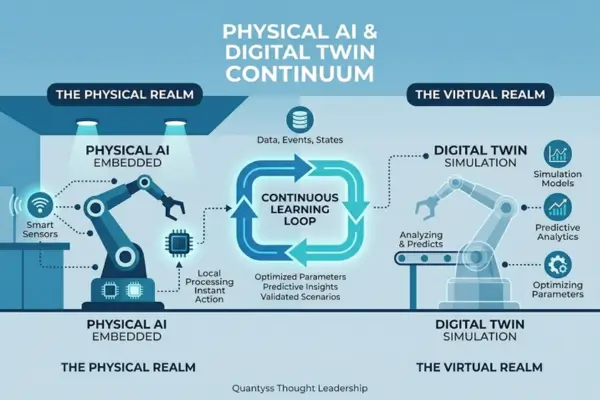
Behind the promise of Physical AI lies a subtle architecture where the real world and the virtual world engage in continuous dialogue.
Embedded algorithms make local decisions, while digital twins simulate, predict, and optimize. Between them, a bidirectional loop creates a system that learns, adjusts, and improves over time.
The Intelligent Mirror: How They Interact
Physical AI and Digital Twins are not separate worlds; they form an intelligent continuum, a strategic alliance for the future of industry:
- Physical AI (The Action): Deployed within microcontrollers and robots for immediate responsiveness and energy frugality.
- Digital Twins (The Reasoning): Living in the cloud or edge platforms to model, simulate, and predict.
The Bidirectional Loop:
Physical AI sends filtered data and local states. In return, the Digital Twin provides optimized parameters and predictive instructions.
A More Resilient and Efficient Future
This integrated architecture is a game-changer for critical infrastructures. It unlocks capabilities that were previously out of reach:
- Dynamic Reconfiguration: Systems that adjust their own settings based on real-time needs.
- Autonomous Diagnostics: Detecting anomalies before they cause downtime.
- Self-Parameterization: Machines that optimize their own performance over time.
Physical AI and digital twins are the engine of a new generation of intelligent systems.
Stay tuned, we will continue to elaborate more precisely on some breakthrough aspects of this major Embedded AI evolution.